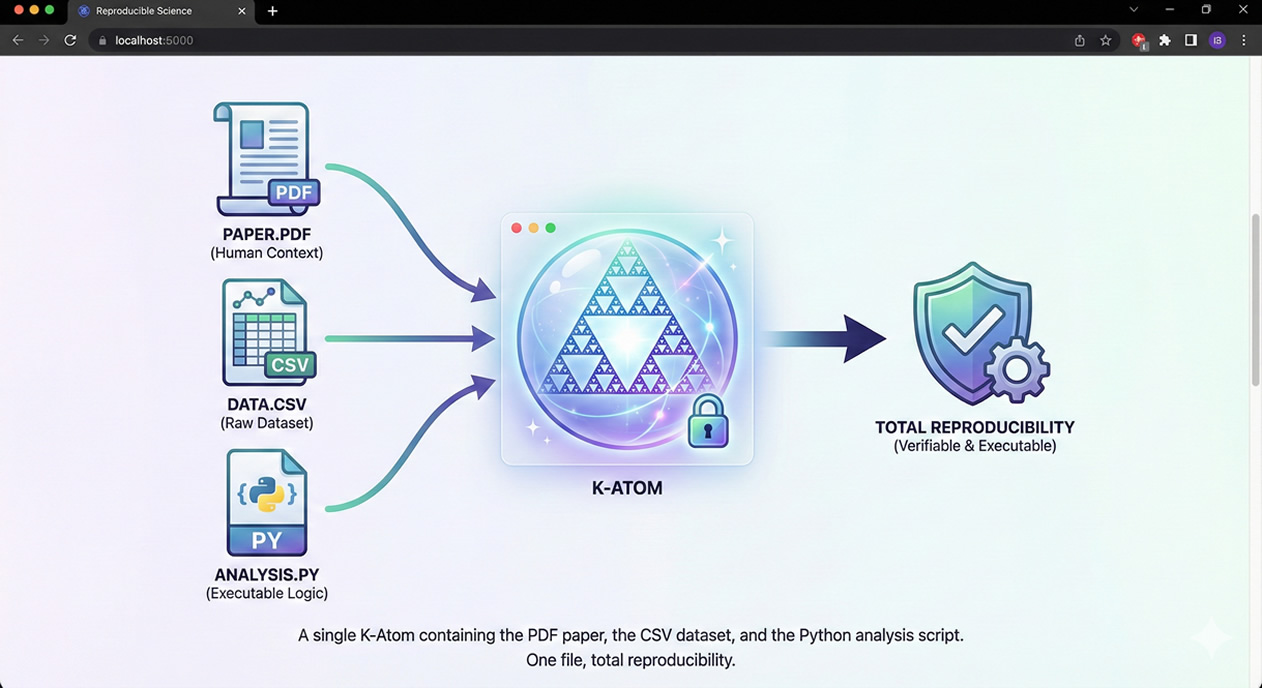
K-ATOM is the Docker for knowledge โ self-contained, reproducible, and portable as an image. A Content-Addressed Knowledge system designed for the era of Human-AI collaboration: an atomic unit of knowledge packaged as a standard image that is simultaneously human-readable, machine-executable, and cryptographically verifiable.
One self-contained object carries full context: data, code, provenance, and identity. Zero infrastructure. Total portability. Built for agents, scientists, pipelines, and the field.

Documents, PDFs, Markdown. Visual and contextual, but "lossy" and hard for machines to parse effectively.
Databases, APIs, Vectors. Structured and operational, but invisible, abstract, and fragile to humans.
The unified primitive. A portable image humans can share, containing a structured DB that agents can read.
Client-side artifact generator & inspector. No server required.
DROP FILE TO SMELT
.MD / .JSON / .CSV / .PDF
Snapshot an agent's entire context window, rules, and intermediate state into a single image. Load it later to resume execution perfectly.
A single K-Atom containing the PDF paper, the CSV dataset, and the Python analysis script. One file, total reproducibility.
Commits you can see. If the code changes, the fractal changes. A grid of K-Atoms becomes a visual history of project evolution.
Agent A outputs a K-Atom. Agent B ingests it. The pipeline isn't a hidden JSON stream; it's a gallery of inspectable artifacts.
Distribute critical manuals and databases via AirDrop or Bluetooth as images. Zero infrastructure required.
Store the K-Atom as the visual node in a GraphDB. Use the payload to generate vector embeddings. The perfect RAG primitive.
Using Ed25519 signatures, authors can cryptographically sign their research. The Viewer verifies provenance instantly.
Print the K-Atom. A mobile agent scans the core, verifies the hash, and downloads the payload. The paper becomes the database.
K-ATOM is a zero-dependency primitive. It runs everywhere.
Clone the repo and open index.html. That's it. No build step, no npm install, no servers.
Copy app.js (renaming to katom.js) into your agent's tools folder. Use it to read/write atoms programmatically.